
John Lock: Fordham backfield star came highly recommended to Green Bay Packers
When healthy, the Luzerne County native was a key contributor to Fordham's star-studded teams of the 1930s.

In the summer of 1938, fans were invited to vote for the Eastern College All-Stars who would play in an exhibition game against the NFL’s Philadelphia Eagles.
The contest was sponsored by the Philadelphia Inquirer and popularized with the help of other newspapers that also solicited and tallied votes.
John Lock, a hard-running fullback from Plains Township, Luzerne County, earned 66,183 votes — fifth most among backs — and made the team.
Lock was an All-American-caliber player whose history of harsh injuries, including a dislocated elbow and broken bones in a foot, limited his production during a four-year career at Fordham University.
Now, however, was Lock’s chance to get himself healthy and show the world what he and his believers, including Jim Crowley and Curly Lambeau, had known all along: that he was a world-class football player.
Only, it wasn’t meant to be.
John Lock was born in 1910 or 1911 in Edwardsville or Kingston. His last name was spelled Lock or Loch. Not uncommon for the era, Lock’s records were littered with discrepancies.
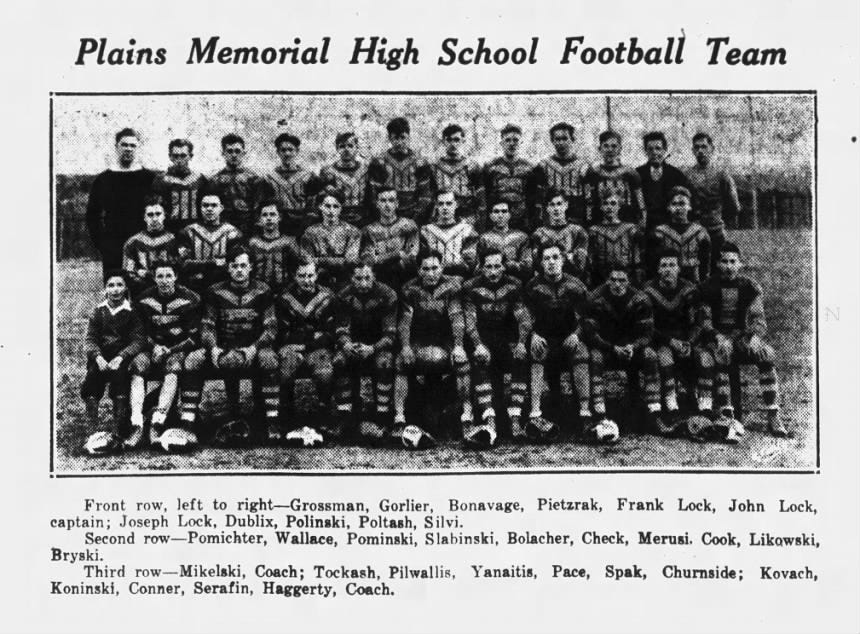
What’s indisputable, however, is that he grew up on Bank Street in Plains Township and graduated from Plains Memorial High School in 1933. In his senior football season, Lock was the team captain and starting fullback. Lock also played baseball and basketball at Plains.
Lock attended Pennington Prep School in New Jersey for an additional year of schooling. Pennington plucked several local standouts thanks to its longtime coach, Harold Poore, who was born in Plymouth and once was neighbors with Edgar Brace, the longtime head coach at Wyoming Seminary prep school in Kingston.
You can bet that losing Lock to Pennington got under Brace’s skin, a feeling that worsened on Sunday, Oct. 8, 1933. That’s when Lock returned to the Wyoming Valley to play against Sem as Pennington’s starting fullback. He led Pennington past Sem, 6-0, at Nesbitt Memorial Stadium.
Following Lock’s postgraduate year at Pennington Prep, the Wilkes-Barre Evening News in June 1934 reported that Crowley had made a home recruiting visit to check on Lock. Crowley, one of the “Four Horsemen of Notre Dame,” had just coached Fordham to a 6-2 record in his first year as head coach.
Lock chose to attend Fordham, where he played one season of freshman and three seasons of varsity football. He was powerfully built, about 5-foot-10, 205 pounds.
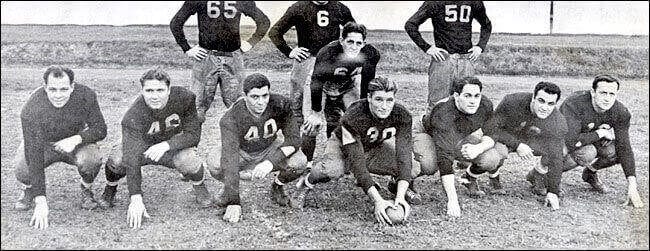
As a junior in 1936 — the year of Fordham’s famed “Seven Blocks of Granite,” anchored by College Football Hall of Fame linemen Alex Wojciechowicz and Ed Franco and Vince Lombardi — Lock was a key backfield member.
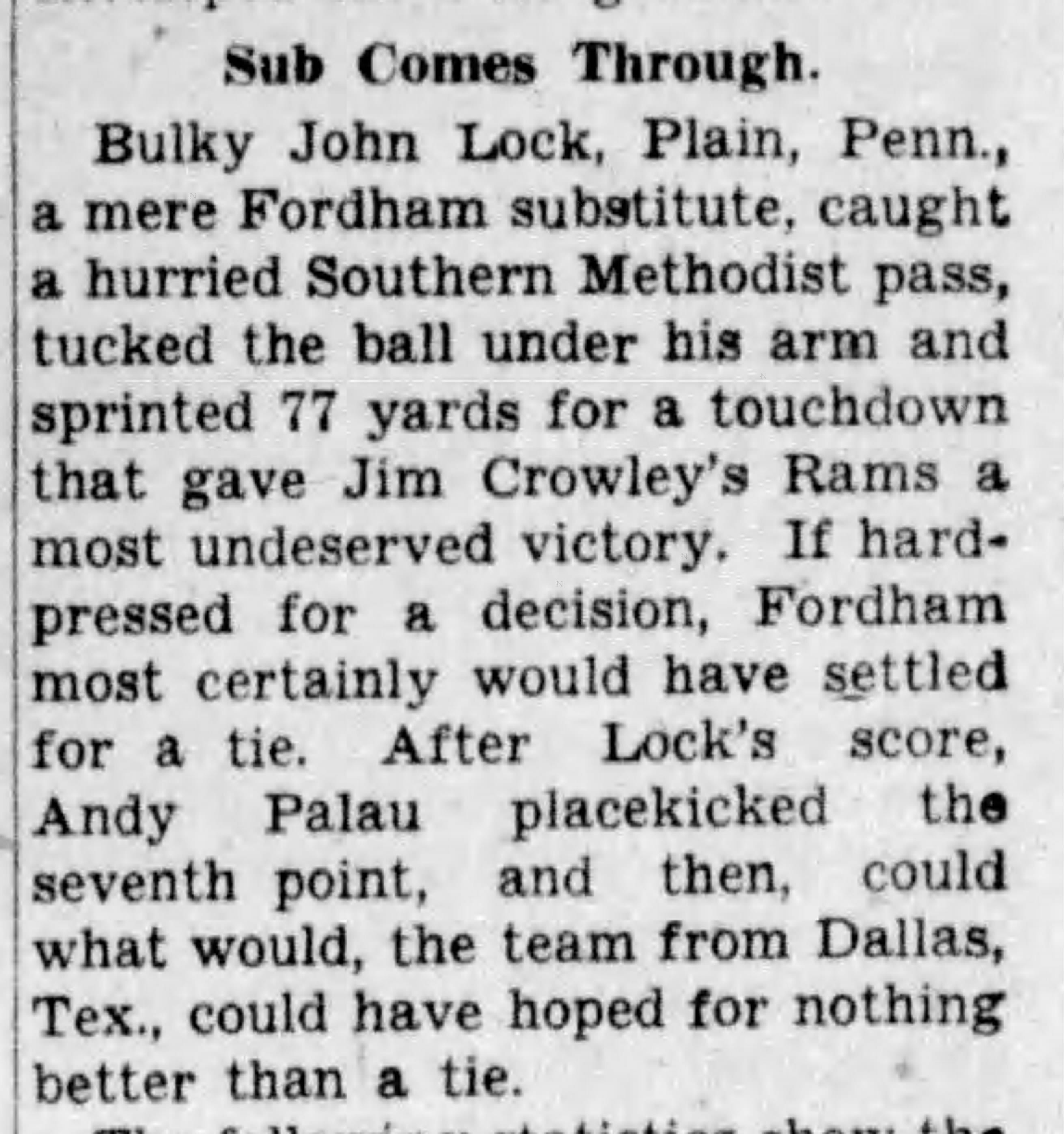
Lock made national headlines for his performance in the Oct. 10 victory against SMU at the Polo Grounds. Fordham won, 7-0, on Lock’s 75-yard interception return for a touchdown, the game’s only score.
“Johnny Lock was a shaky hero, nauseous since reaching the end zone,” author David Maraniss wrote in his stellar Lombardi biography “In the excitement of the moment, dashing downfield on his run to glory, he had swallowed a wad of tobacco.”
After helping Fordham go 5-1-2 in 1936, Lock returned in 1937, primed to play an even greater role for the Rams. However, he was dogged by injuries, including on his finest days. Lock’s 44-yard run helped set up the winning touchdown against Saint Mary’s, although he was carried off the field with a dislocated elbow before Fordham crossed the goal line. Fordham finished with a 7-0-1 record.
After graduating from Fordham in 1938 with an economics degree, Lock was voted into the aforementioned exhibition game between the Eastern College All-Stars and the Eagles. It was played Wednesday, Aug. 24, at Temple Stadium.
Lock was the all-stars’ starting fullback. George Platukis, a Duquesne grad from West Hazleton, started at end. Gordon Davies, a Lebanon Valley grad and guard from Kingston, was also on the roster.
According to the Philadelphia Inquirer’s exceptionally detailed play-by-play account of the game, Lock exited the game in the first quarter — on the first series of downs — and never returned. It was an unspecified injury to his leg. The Eagles won, 14-7.
Nonetheless, Lock’s football career continued. He was under contract with the Packers, who signed him in March, long before the all-star game. He came personally recommended by Crowley, a Green Bay native who later lived in Scranton, to Lambeau, the Packers’ head coach from 1921-1949.
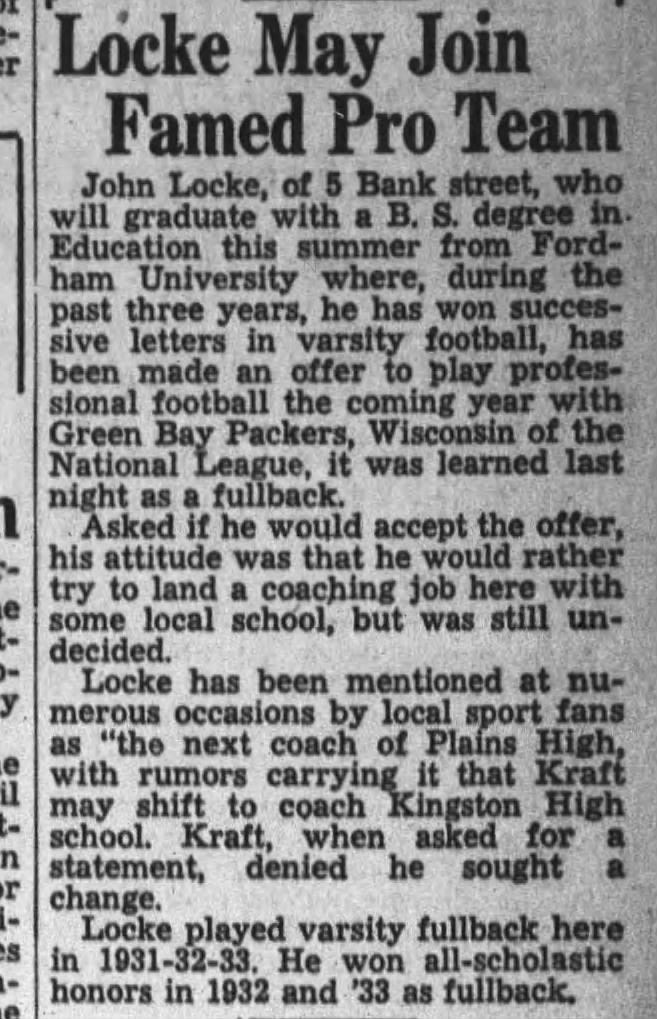
Lock’s Packers career was brief. He was cut only a few weeks into the 1938 season.
The circumstances around Lock’s release actually led the Packers to institute a new policy. Remember, the all-star game was Aug. 24. The Packers’ first regular-season game was only two-and-a-half weeks later on Sept. 11.
“Lock is good enough to make any team in the National League, and it is with regret that we announce his release,” Lambeau said. “It was unfortunate that he participated in an Eastern All-Star game and reported to us with no preliminary work. He also reported with a slight injury and we have been unable to use him in our games to date.
“In the future, the Packer corporation will not permit men it has signed to participate in all-star games other than that sponsored by the Chicago Tribune Charities, Inc.”
Lock was brought back by the Packers the following summer, only to be cut again in September. The 1939 Packers won the NFL championship.
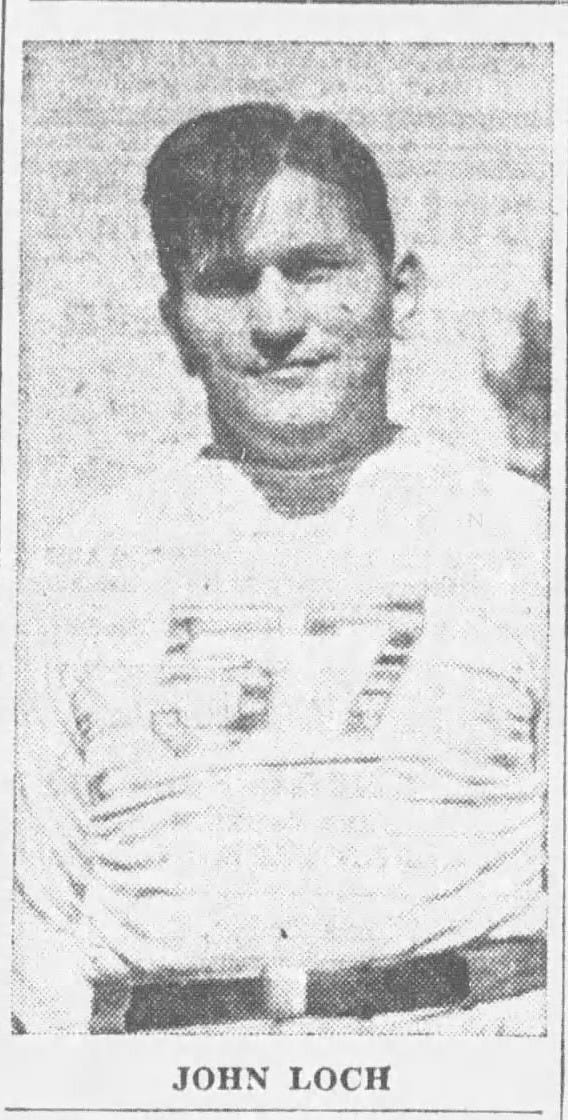
As his playing career ended, Lock transitioned into a role as coach and teacher in New Jersey schools. He retired from coaching in 1963, due to poor health, but continued teaching until his death.
Lock, 55, died Saturday, Oct. 28, 1967, at his vacation home in Cherry Ridge Township, near Honesdale, Wayne County. Among his survivors was his wife Sylvia Lock.
FINAL WORD: It’s rather tragic, don’t you think, that Lock’s crowning individual achievement (making the Eastern All-Stars) led to the circumstances (injury, missing training camp) that effectively ended his playing career? Don’t overlook that he accomplished plenty in his career — playing with Vince Lombardi, playing for Jim Crowley, making big plays to preserve undefeated records in college and signing an NFL contract. Yet, the question of “What if?” lingers.